On this page

Your site has topics. Now turn them into a structure that tells both visitors and Google exactly what you offer. This lesson sets up your navigation and content silos. Return to the workshop overview to see how this fits into the full sequence, or revisit your first build and styling if you skipped ahead.
What is a content silo
A silo is a group of pages about one subject. All pages in the silo link to each other and to an index page at the top. Google sees this structure and understands: "This site has deep expertise in this subject."
Your topics are already silos. If you have a "Roasters" topic with 10 pages about different roasters, Google sees 10 interlinked pages all pointing to the roasters index. That is stronger than 10 random pages scattered across a flat site.
The two-row navigation
Wire builds a two-row header. The first row shows your site name and offering links. The second row shows content pages within the current topic.
Tell your agent:
Set up our offerings navigation. The first row should highlight our three main offerings: Roasters, Origins, and Brewing. Each one links to its topic index. Add a CTA button in the header that says "Find Your Roaster" and links to a new page at /find-roaster/ with layout: landing.
What happens
Your agent updates wire.yml to configure the offerings and CTA. Wire builds a two-row header:
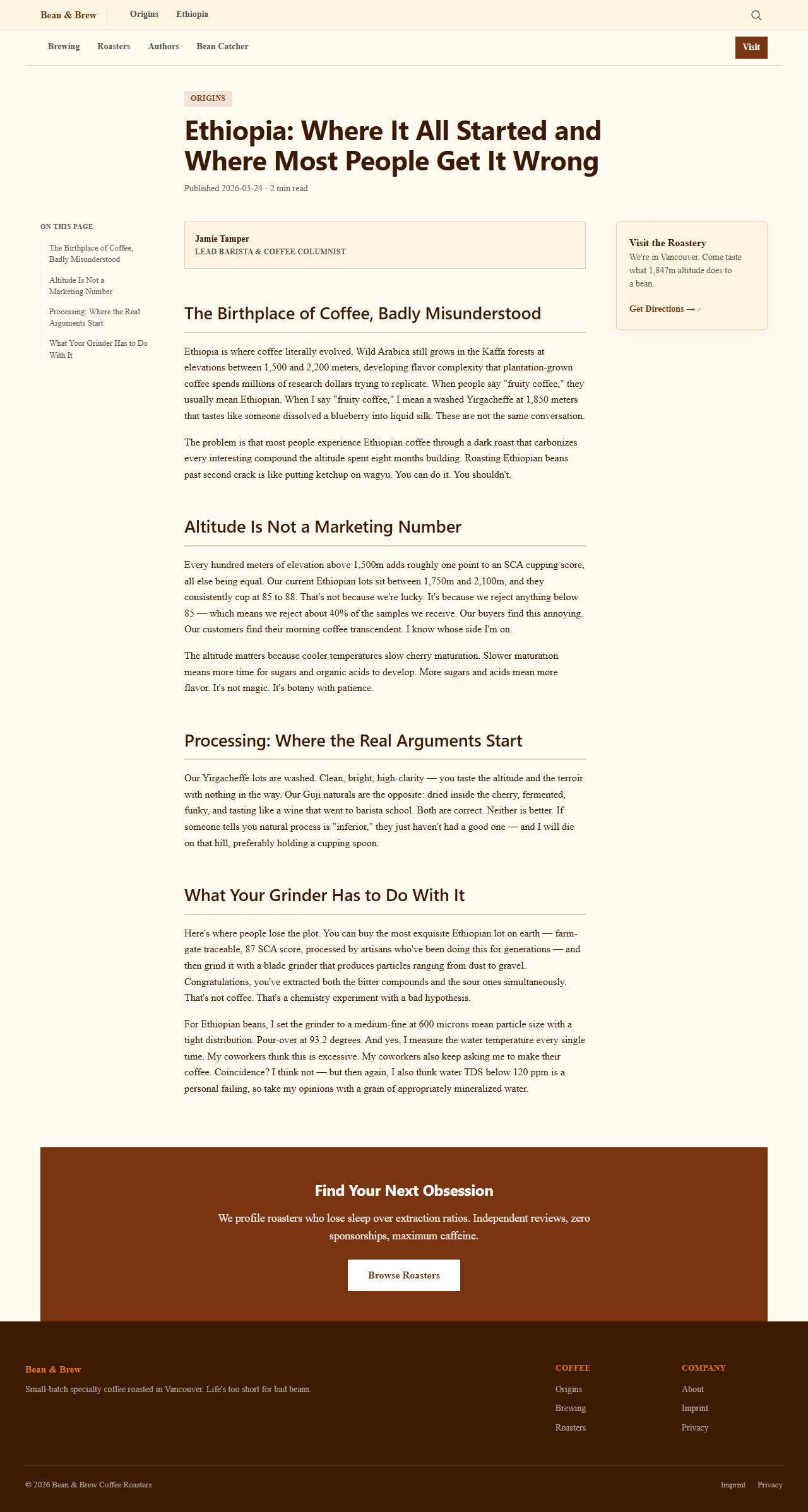
Row 1 (stays visible as you scroll): Your site name, the main offering categories, and a CTA button. This is your brand bar. It tells every visitor what you sell before they read a single word.
Row 2 (scrolls away): The content pages within the current topic. When a visitor clicks "Origins" in Row 1, Row 2 shows all origin pages (Ethiopia, Colombia, Brazil). When they click "Roasters", Row 2 shows all roaster profiles.
The CTA button ("Find Your Roaster" in this example) sits in the top-right of Row 1. It appears on every page. It links to a landing page you control.
Why this matters for SEO
Flat sites with 60 pages in one list confuse Google. It cannot tell what your main topics are. Content silos solve this:
- Each silo has an index page that ranks for the broad keyword ("specialty coffee roasters")
- Child pages rank for specific keywords ("Ethiopian coffee roasters in Berlin")
- Internal links within the silo pass authority upward to the index
- The two-row nav tells visitors (and Google) what your site is about before they scroll
Go deeper
- Configuration reference covers nav, header, offerings, and CTA setup
- Internal linking explains how Wire builds link equity within silos
- SEO reference presents the evidence behind content silos